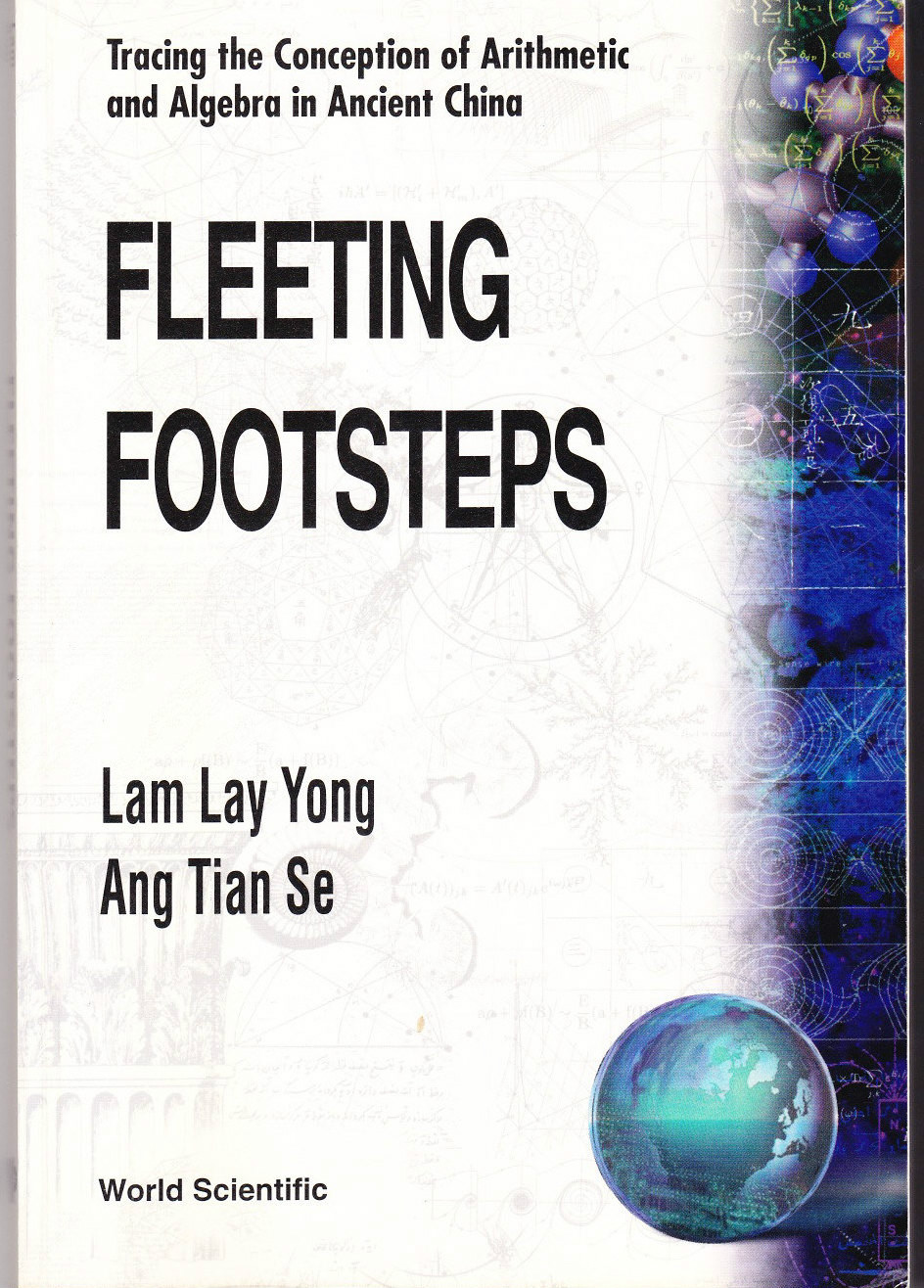
1992年,藍麗蓉出版了她的代表作:《雪泥鴻爪朔數源》(Fleeting Footsteps, Tracing the Concept of Arithmetic and Algebra in Ancient China)。她在書中詳述中國五世紀《孫子算經》的十進位制籌算的記數法則、和加、減、乘、除、分數運算、開平方運算的程式,還詳細比較九至十世紀阿拉伯著名數學家花拉子米、伊本·拉班關於印度算法的多種著作,發現阿拉伯國家早期關於印度算法中的四則運算和開平方方的程式,和孫子算經中的方法十足相同,從而提出印度-阿拉伯數字系統的十進位制概念,乃起源於中國算籌的學說她說,她之所以能夠做出這個跨文明的重要發現,乃因以往西方數學史家不通中算史的中文文獻,而中國中算史家又不容易取得西方圖書館的文獻,而她自己則中西文獻可以兼而得之之故。《雪泥鴻爪朔數源》一書在2004年再版,其本內容大致和92年版相同,但增加一篇她在2002年在北京召開的國際數學史大會上,在榮獲凱尼斯·梅獎之後的致謝演講,題為《中國古代的數學及其對世界數學的影響》(Ancient Chinese Mathematics and its influence on World Mathematics)作為代序,和著名數學史家 Joseph Dauben 的引言。Fleeting Footsteps
Lam Lay Yong (1994). "Jiu Zhang Suanshu (Nine Chapters on the Mathematical Art): An Overview", Archive for History of Exact Sciences, vol. 47
Lam Lay Yong (1977). "A Critical Study of the Yang Hui suan fa". NUS Press.
Lam Lay Yong (1997). "Zhang Qiujian Suanjing (The Mathematical Classic of Zhang Qiujian): An Overview", Archive for History of Exact Sciences, vol. 50.
Lam Lay Yong, Ang Tian Se (1992). Fleeting Footsteps, Tracing the Concept of Arithmetic and Algebra in Ancient China. World Scientific.
Lam Lay Yong. "A Chinese Genesis, Rewriting the history of our numeral system", Archive for History of Exact Science, vol. 38, 101-108.
Lam Lay-Yong and Shen Kangshen (沈康身). "Methods of solving linear equations in traditional China", Historia Mathematica, Volume 16, Issue 2, May 1989, pp 107-122.
 Fleeting Footsteps