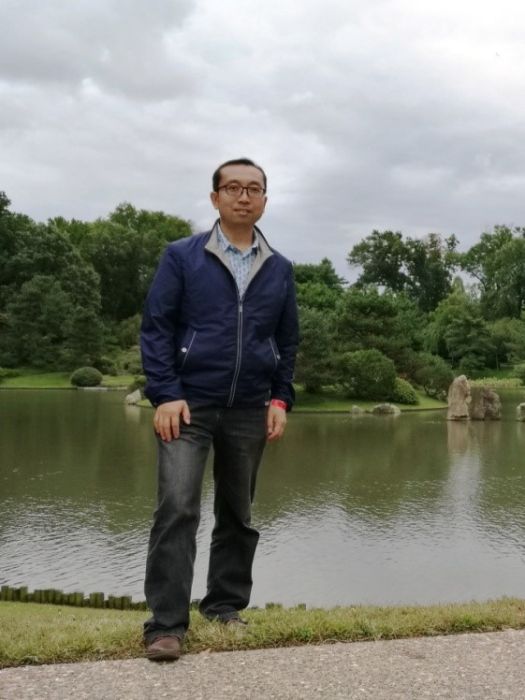
路永鋼,男,博士,蘭州大學信息科學與工程學院教授,博士生導師,計算機軟體與理論研究所所長。
基本介紹
- 中文名:路永鋼
- 學位/學歷:博士
- 職業:教師
- 專業方向:機器學習
- 任職院校:蘭州大學信息科學與工程學院
人物經歷,主講課程,研究方向,學術成果,榮譽獲獎,學術兼職,
人物經歷
教育背景
1992.09–1996.07,蘭州大學,物理系,國家基礎理論人才培養基地,學士
1996.09–1999.07,蘭州大學,物理系,凝聚態物理專業,碩士
2002.08–2004.07,美國新墨西哥州立大學,計算機科學系,碩士
2004.09–2007.12,美國新墨西哥州立大學,計算機科學系,博士
工作經歷
2007.12–2010.02,美國休斯敦殼牌石油公司Savior軟體部,軟體工程師
2010.03–2015.05,蘭州大學信息科學與工程學院,副教授
2015.06-,蘭州大學信息科學與工程學院,教授
主講課程
主講本科生課程:《算法設計與分析》
主講研究生課程:《數理統計與隨機過程》、《鏈路挖掘》
研究方向
機器學習、模式識別、計算機視覺、生物信息
學術成果
主持參與完成的項目:
國家自然科學基金面上項目
中央高校基本科研業務費重要學科領域項目
中國石油勘探開發研究院西北分院技術開發項目
中國科學院近代物理研究所技術開發項目
目前在研項目:
國家重點研發計畫子課題
國家重點研發計畫子課題
發表論文及專著
發表SCI/EI論文50餘篇,近5年主要的SCI/EI論文如下:
[1]Huanqian Yan, Lei Wang, Yonggang Lu*, (2019). “Identifying cluster centroids from decision graph automatically using a statistical outlier detection method”, Neurocomputing, 329, 348-358.
[2]Xu Han, Li Li and Yonggang Lu*, (2019). “Selecting Near-Native Protein Structures from Predicted Decoy Sets Using Ordered Graphlet Degree Similarity”, Genes, 10(2), 132-144;
[3]Xin Hong, Hailin Li, Paul Miller, Jianjiang Zhou, Ling Li, Danny Crookes, Yonggang Lu, Xuelong Li, Huiyu Zhou, (2019). “Component-based Feature Saliency for Clustering”, IEEE Transactions on Knowledge and Data Engineering.
[4]Xiangwen Wang, Yonggang Lu*, Zhenyu Lu, Xingcheng Ran, Jiaxuan Liu, (2019). A Weighted Voting Algorithm for Detecting Reliable Common Lines in Single Particle Cryo-EM, BIBM 2019:98-101.
[5]Xingcheng Ran, Yonggang Lu*, Xiangwen Wang, and Zhenyu Lu, (2019). Hypergraph clustering by generating large pure hyperedges using greedy neighborhood search, FSDM 2019: 152-159.
[6]Wenjie Guo, Li Yang, Yonggang Lu*, Yi Yang, Lian Li, Zongli Liu, (2019).Information Hiding in OOXML Format Data based on the Splitting of Text Elements. ISI 2019: 188-190.
[7]Peiyu Kang, Yonggang Lu*, Diqi Pan, Wenjie Guo. (2019). Improving the Dictionary Construction in Sparse Representation using PCANet for Face Recognition. ICPRAM 2019: 517-523.
[8]Diqi Pan, Yonggang Lu*, Peiyu Kang. (2019). A Deep Learning Model for Multi-label Classification Using Capsule Networks. ICIC 2019: 144-155.
[9]Li Li, Huanqian Yan, Yonggang Lu*, (2018). “Selecting Near-native Protein Structures from Ab Initio Models Using Ensemble Clustering”, Quantitative Biology, 6, 307–312.
[10]Zhiqiang Zhang, Yonggang Lu, Shaoliang Peng, A Dictionary Learning Algorithm for Gene Expression Profile Classification Based on Feature Selection, IRCE 2018: 203-207.
[11]Lei Wang, Yonggang Lu*, Huanqian Yan, (2018). “A Fast and Robust Grid-Based Clustering Method for Dataset with Arbitrary Shapes”, FSDM 2018: 636-645
[12]Qi Wang, Yonggang Lu*, (2018). “Relationship Between Weight Correlation of the Convolution Kernels and the Optimal Architecture of CNN”, FSDM 2018: 653-662.
[13]Jing He, Kamal Al-Nasr, Weitao Sun, Yonggang Lu, (2018). “Special Issue Preface: The 9th Computational Structural Bioinformatics Workshop”. Journal of Computational Biology 25(1): 1-2 (2018).
[14]Xiangyu Jiang, Yonggang Lu*, Zhenyu Lu, Huiyu Zhou, (2018). “Smartphone-Based Human Activity Recognition Using CNN in Frequency Domain”. APWeb/WAIM 2018: 101-110.
[15]Zhijuan Wang, Yonggang Lu*, (2018). “Improving Initial Model Construction in Single Particle Cryo-EM by Filtering Out Low Quality Projection Images”. ICIC: 589-600.
[16]Huanqian Yan, Yonggang Lu*, and Heng Ma, (2018). “Density-based Clustering using Automatic Density Peak Detection”, ICPRAM 2018. ICPRAM 2018: 95-102.
[17]Yonggang Lu, Ye Wei, Li Liu, Jun Zhong, Letian Sun, Ye Liu. (2017). “Towards unsupervised physical activity recognition using smartphone accelerometers”. Multimedia Tools and Applications, 76:10701-10719.
[18]Huanqian Yan, Yonggang Lu* and Li Li, (2017). “A Potential-based Density Estimation Method for Clustering using Decision Graph”, IDEAL 2017: 73-82.
[19]Xianlong Wang, Yonggang Lu*, Dachuan Wang, Li Liu, and Huiyu Zhou, (2017). “Using Jaccard Distance Measure for Unsupervised Activity Recognition with Smartphone Accelerometers”, APWeb-WAIM 2017: 74-83
[20]Tian Wang, Yonggang Lu*, Yuxuan Han. (2017). “Clustering of High Dimensional Handwritten Data by an Improved Hypergraph Partition Method”, ICIC 2017: 323-334.
[21]Yonggang Lu, Jiangang Qiao, Xiaochun Wang. (2017). “K-normal: An Improved K-means for Dealing with Clusters of Different Sizes”. ICIC 2017: 335-344.
[22]Hu Cao, Yonggang Lu*, (2017). “Using Variable-length Aligned Fragment Pairs and an Improved Transition Function for Flexible Protein Structure Alignment.” Journal of Computational Biology. Vol. 24(1), pp. 2-12. Jan., 2017
[23]張變蘭,路永鋼*,張海濤,(2017). “基於KL散度和近鄰點間距離的球面嵌入算法”,《計算機套用》,37(3): 680-683, 690.
[24]Yonggang Lu*, Xiaoli Hou, Xurong Chen. (2016). “A Novel Travel-Time Based Similarity Measure for Hierarchical Clustering.” Neurocomputing. Vol. 173, pp. 3-8.
[25]Xingmei Liu, Yonggang Lu*, Hu Cao, (2016). “Non-sequential Protein Structure Alignment Based on Variable Length AFPs Using the Maximal Clique.” BIBM 2016:1720-1725.
[26]Jinyang Yan, Yonggang Lu*, Jing He, (2016). “Selecting Near-native Structures From Decoys Using Maximal Cliques.” BIBM 2016: 1745-1748.
[27]Haitao Zhang, Zhuo Cheng, Cong Tian, Yonggang Lu, Guoqiang Li, (2016). “Verifying OSEK/VDX applications: An optimized SMT-based bounded model checking approach.” ICIS 2016: 1-6.
[28]Heng Ma, Yonggang Lu* and Haitao Zhang, (2016). “Determining the Near Optimal Architecture of Autoencoder using Correlation Analysis of the Network Weights”, IJCCI 2016:53-61.
[29]Dachuan Wang, Li Liu, Xianlong Wang, Yonggang Lu*, (2016). 'A Novel Feature Extraction Method on Activity Recognition Using Smartphone.' Lecture Notes in Computer Science,Volume 9998, pp. 67-76.
[30]Xili Sun, Yonggang Lu*. (2016). “Locally linear embedding based on Rank-order distance.” ICPRAM 2016: 162-169
[31]田守財,孫喜利,路永鋼*,(2016),“基於最近鄰的隨機非線性降維”,《計算機套用》,36卷,2期,377-381頁.
[32]Xili Sun, Shoucai Tian, Yonggang Lu*. (2015). “High Dimensional Data Clustering by Partitioning the Hypergraphs using Dense Subgraph Partition”, Proceedings of SPIE, 98130B. pp. 98130B-1 - 98130B-9,
[33]Ye Wei, Li Liu, Jun Zhong, Yonggang Lu*, and Letian Sun,(2015).“Unsupervised Race walking recognition using smartphone accelerometers”, Lecture Notes in Computer Science, Vol. 9403, pp 691-702.
[34]Hu Cao, Yonggang Lu*, (2015). “Flexible Protein Structure Alignment by Variable-length Aligned Fragment Pairs.” BIBM 2015:1280-1286.
榮譽獲獎
ICPRAM 2018國際會議最佳論文獎
2022年1月12日,獲頒首批“金城首席科普專家”聘書。
學術兼職
擔任 中國人工智慧學會科普工作委員會委員
擔任 國家自然科學基金重點項目、面上項目和青年項目學術評審
擔任 國家科學技術獎評審專家
擔任BIBM國際會議程式委員會委員
擔任《軟體》雜誌第十二屆期刊編委
擔任《計算機學報》期刊學術評審
擔任《自動化學報》期刊學術評審
擔任《Neurocomputing》期刊學術評審
擔任《IEEE Trans. on Neural Networks and Learning Systems》期刊學術評審
擔任《IEEE Trans. On Systems, Man, and Cybernetics》期刊學術評審
擔任《IEEE & ACM Transactions on Computational Biology and Bioinformatics》期刊學術評審
擔任《IEEE Access》期刊學術評審
擔任《Journal of Computational Biology》期刊學術評審
擔任《International Journal of Data Mining and Bioinformatics》期刊學術評審
擔任《International Journal of Pattern Recognition and Artificial Intelligence》期刊學術評審
擔任《Computers and Electrical Engineering》期刊學術評審
擔任《Briefings in Functional Genomics》期刊學術評審
擔任 蘭州大學信息科學與工程學院 學術委員會委員
