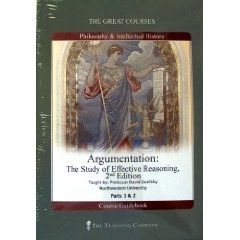
《The Great Courses - Philosophy & Intellectual History - Argumentation》是The teaching Company出版的圖書,作者是The Teaching Company
基本介紹
- ISBN:9781598031164
- 作者:The Teaching Company
- 出版社:The teaching Company
- 出版時間:2005年
- 頁數:24 lectures, 30 minutes/lecture
- 定價:US$ 179.95
- 裝幀:Audio CD
內容簡介
What is effective argument? * It is Abraham Lincoln at Cooper Union in 1860, marshalling many lines of evidence to make the case that Congress has the power to regulate slavery. * It is Franklin D. Roosevelt in a 1940 "fireside chat," employing a vivid analogy to convince Americans to lend war equipment to Great Britain, then battling Nazi Germany alone. * It is the U.S. Suprem...(展開全部) What is effective argument? * It is Abraham Lincoln at Cooper Union in 1860, marshalling many lines of evidence to make the case that Congress has the power to regulate slavery. * It is Franklin D. Roosevelt in a 1940 "fireside chat," employing a vivid analogy to convince Americans to lend war equipment to Great Britain, then battling Nazi Germany alone. * It is the U.S. Supreme Court in 1954, using complex reasoning to decide unanimously that segregated schools are unconstitutional in Brown v. Board of Education. * It is any individual or organization, drawing on the theory of argumentation to reason through a position and make the best possible case for it. Argumentation: The Study of Effective Reasoning, 2nd Edition, is a rigorous introduction to the formal study of argumentation—communication that seeks to persuade others through reasoned judgment. In 24 lectures you learn the building blocks of an argument, the different categories of argument and the issues that are at stake in each, the kinds of evidence that serve as proof in an argument, and many other aspects of argumentation and reasoning, illustrated with examples from some of the most famous speeches, debates, and controversies in American history. What You Learn Award-winning Professor David Zarefsky of Northwestern University has five goals for this course: 1. You will learn how to recognize arguments; how to find them in conversations, newspaper editorials, speeches, in controversies of any kind; and how to know them when you encounter them. 2. You will become
