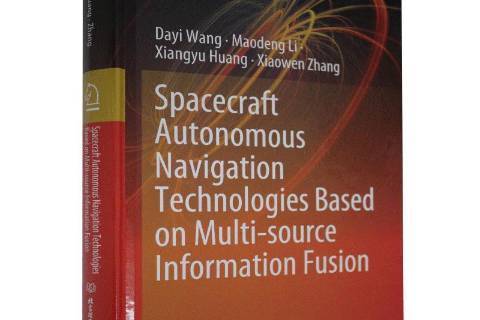
《Spacecraft Autonomous Navigation Technologies Based on Multi》是2020年北京理工大學出版社出版的圖書。
基本介紹
- 外文名:Spacecraft Autonomous Navigation Technologies Based on Multi
- 作者: Dayi Wang//Maodeng Li//Xiangyu Huang//Xiaowen Zhang
- 出版時間:2020年
- 出版社:北京理工大學出版社
- ISBN:9787568290081
- 開本:16 開
- 裝幀:精裝
內容簡介,作者簡介,圖書目錄,
內容簡介
This book introduces readers to the fundamentals of estimation and dynamical system theory, and their applications in the field of multi-source information fused autonomous navigation for spacecraft. The content is divided into two parts: theory and application. The theory part (Part I) covers the mathematical background of navigation algorithm design, including parameter and state estimate methods, linear fusion, centralized and distributed fusion, observability analysis, Monte Carlo technology, and linear covariance analysis. In turn, the application part (Part II) focuses on autonomous navigation algorithm design for different phases of deep space missions, which involves multiple sensors, such as inertial measurement units, optical image sensors, and pulsar detectors. By concentrating on the relationships between estimation theory and autonomous navigation systems for spacecraft, the book bridges the gap between theory and practice. A wealth of helpful formulas and various types of estimators are also included to help readers grasp basic estimation concepts and offer them a ready reference guide.
作者簡介
王大軼,研究員,現任中國空間技術研究院總體部副部長,中國宇航學會英文刊Advances in Astronautics Science and Technology(《航天科技前沿》)編委,國家傑出青年科學基金獲得者,國防科技卓越青年科學基金獲得者,國家萬人計畫科技創新領軍人才,“973項目”技術首席專家。在太空飛行器自主導航與控制領域進行創新研究工作,解決了一系列關鍵技術問題,為嫦娥月球探測器等型號飛行試驗成功做出了貢獻。2016年獲何梁何利基金科學與技術創新獎,2017年入選***百千萬人才工程,是國務院政府特殊津貼專家、國家有突出貢獻中青年專家。獲國家技術發明二等獎1項,部級一等獎4項、二等獎4項。
圖書目錄
1 Introduction
1.1 Autonomous Navigation Technology
1.1.1 Inertial Navigation
1.1.2 Autonomous Optical Navigation
1.1.3 Autonomous Pulsar-Based Navigation
1.2 Multi-source Information Fusion Technology
1.2.1 Definition of Multi-source Information Fusion
1.2.2 Classification of Multi-source Information Fusion Technologies
1.2.3 Multi-source Information Fusion Methods
1.3 Autonomous Navigation Technology Based on Multi-source Information Fusion
1.3.1 Research and Application Progress
1.3.2 Necessity and Advantages
1.4 Outline
References
2 Point Estimation Theory
2.1 Basic Concepts
2.2 Common Parameter Estimators
2.2.1 MMSE Estimation
2.2.2 ML Estimator
2.2.3 Maximum a Posteriori (MAP) Estimator
2.2.4 Weight Least-Square (WLS) Estimator
2.3 Closed Form Parameter Estimators
2.3.1 Linear Estimator
2.3.2 MMSE Estimator for Jointly Gaussian Distribution
2.3.3 Estimation Algorithms for Linear Measurement Equation
2.4 State Estimation Algorithms in Dynamic Systems
2.4.1 Recursive Bayesian Estimation
2.4.2 Kalman Filtering
2.4.3 Extended Kalman Filtering
2.4.4 Unscented Kalman Filtering
2.4.5 Constrained Kalman Filtering
2.5 Brief Summary
References
……
3 Estimation Fusion Algorithm
4 Performance Analysis
5 Time and Coordinate Systems
6 Dynanuc Models and Environment Models
7 Inertial Autonomous Navigation Technology
8 Optical Autonomous Navigation Technology
9 Optical/Pulsar Integrated Autonomous Navigation Technology
10 Altimeter and Velocimeter-/Optical-Aided Inertial Navigation Technology
11 Simulation Testing Techniques for Autonomous Navigation Based on Multi-source Information Fusion
12 Prospect for Multi-source Information Fusion Navigation
Appendix
