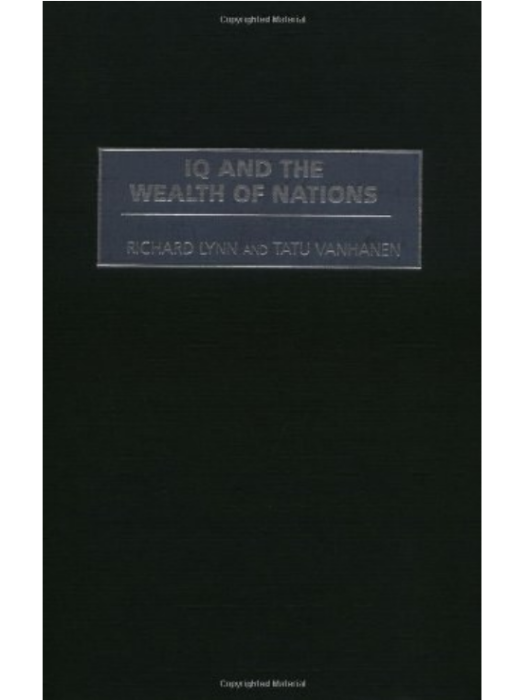
《IQ and the Wealth of Nations》是Richard Lynn、Tatu Vanhanen合著的學術著作,2002年由美國Praeger出版社出版精裝本,全書共298頁。
該書通過收集智力測試數據,分析國家平均智商(national IQ)與人均收入、經濟成長率等經濟指標的相關性,主張智力水平對國家經濟差異具有解釋作用。研究採用統計學方法論證個體智商與收入的關係,並將樣本擴展至185個國家驗證結論,認為國家智商水平可解釋約50%的國別經濟差異。該研究引發學術界關於智商測量方法與因果關係的討論,部分學者提出反向因果關係的質疑。
基本介紹
- 外文名:IQ and the Wealth of Nations
- 作者:Richard Lynn、Tatu Vanhanen
- 出版時間:2002年2月28日
- 出版社:Praeger
- 頁數:320 頁
- ISBN:9780275975104
- 定價:102.95 美元
- 裝幀:Hardcover
內容簡介
This work tests the hypothesis on the causal relationship between the average national intelligence (IQ) and the gap between rich and poor countries by empirical evidence. Based on a survey of national IQ tests, their results challenge previous theories of economic development and provide a new basis to evaluate the prospects of economic development throughout the world. They begin by reviewing and evaluating some major previous theories. The context of intelligence is then described and IQ introduced. Next they show that intelligence is a significant determinant of earnings within nations, and they connect intelligence with various economic and social phenomena. The sociology of intelligence at the level of sub-populations in nations is examined, and the independent (national IQ) and dependent (various measures of per capita income and economic growth rates) variables are defined and described. They then provide empirical analyses starting from the 81 countries for which direct evidence of national IQ is available; the analysis is then extended to the world group of 185 countries.
